How my tech job prepared me for an AI Takeover
Here’s what we’ll learn in this article:
1. What we need to know about the Substack data leak
2. How are we being fooled into thinking we need more biometric security?
3. How to read between the lines of cybersecurity protocols
4. How an army of bots is waging identity war on humanity
5. How we're being guilted into using AI
"Wait beside the river long enough, and the bodies of your enemies will float by.”
~ James Clavell, Shōgun*
Gazing down upon the dry creek bed behind our house, I look for signs of water. Instead all I see is its jagged spine of arid rock, twisting, clamoring, to quench its thirst. Currents feeding streams currently feed data centers where hard drives erase the hard lessons of life. Wells of imagination run dry as children trade daydreams for tablets, rowing down a frigid virtual stream where strangers steer their fated vessels into an abyss.
How did we wind up this far down the technological river without a paddle?
In my past life as a computer salesman, we’d advise clients on the costly payment card industry data security standards (PCI-DSS) they needed to install if they wanted to keep running credit cards through the internet on their point-of-sale (POS) system. Many of my customers chose to revert to dial-up, which didn’t have the same stringent security standards. It’s much more difficult to tap a physical landline and capture credit card data than to have an internet connection where you can hack into an IP (internet protocol) address. If a client wanted to keep processing credit cards through the internet, they’d often have to upgrade their POS system’s hardware, which would cost anywhere between $5,000 to $100,000. If you’re selling pizzas, this is a considerable chunk of change.
Side note: Does anyone remember the manual credit card imprinter?
Oh, how I miss the smell of that carbon paper…
Owners had no idea if someone’s credit card would work - but that was the natural intelligence of trust at play.

Why were we pushing for tougher software security? Credit card processors got their marching orders from banks, which would quickly come up with security regulations in response to a crisis. For instance, in 2013 there was a nationwide data breach at Target, as hackers exposed personal and financial information of over 40 million customers. The attackers gained access through compromised credentials belonging to a third-party vendor, resulting in the theft of credit card details, email addresses, and phone numbers. Malicious activity was detected on November 27th but wasn’t disclosed until late December.
In 2015, Home Depot had the payment details of 56 million customers stolen by hackers who had gained access to third-party login credentials. To add insult to injury, both Home Depot and Target were already PCI-DSS compliant, abiding by the rules of credit card processors at the time of the data breach. Banks and merchant service providers still did not hesitate to push for tougher security, even though these upgrades would do little to prevent an attacker from being able to steal, or buy, someone else’s password.
Today not only pizza joints, but all people who use social media are being told that they need to pay a price, which will ultimately be much more than $10,000. Even though biometric and age verification are being implemented on Substack and other social media sites, it seems as though these platforms are becoming even less secure.
Seeing the smokestack forest for the trees
Recently Substack announced a data breach where user accounts, emails, phone numbers and meta data (includes account creation dates, subscription information, and IP addresses) were exposed. The breach initially occurred in October, but it took Substack four months to notice. In a world where enterprise security teams typically measure threat detection in hours, how did this 120-day lag even happen?
Ivan Mehta of Tech Crunch blog was the first to report on the issue:
“It’s not clear what exactly the issue was with its systems, and the scope of the data that was accessed. It’s also not yet known why the company took five months to detect the breach, or if it was contacted by hackers demanding a ransom.
Substack did not say how many users are affected.”
Some speculate the hack occurred due to limitations in the automated threat detection capabilities of Substack. Tech Crunch did reach out to Substack for comment, but to date no one knows how the attack occurred.
Let us take the mindset of online security to its logical end:
What would be the ultimate way to prevent hackers from accessing someone’s information?
What would be even more secure than a biometric facial scan?
A retinal scan?
Hackers are already employing what are called injection attacks, where they can write code and fabricate someone else’s identity using data from AI. By leveraging camera emulators and specialized software, hackers simulate live streams, bypassing the need for a physical camera or presence.1
What about a full body scan using the same millimeter wave technology of airports?
This may not be too far-fetched, as Microsoft patents like 2020060606A12 could very easily work with wireless networks by employing ultrawide band (UWB) communications, pinpointing our location to within 30 centimeters.
A hacker could replicate our retina or selfie, but one could argue that reproducing our dynamic movements and bodily activity would be far more difficult. In theory, this form of solitary confinement ironically aims to create the freedom to be free of identity theft. However, if history is to tell us anything, it’s that hackers don’t keep up with technology, they stay ahead of it.
Even though one could argue that prison cells are very safe from the outside world, they still leave you exposed to the general population of other criminals. You won’t get run over by a car when in prison, but if your enemy has keys to your cell, then you are left vulnerable in a bleak forest where no one will hear you shouting.
Grandma wants a fake ID
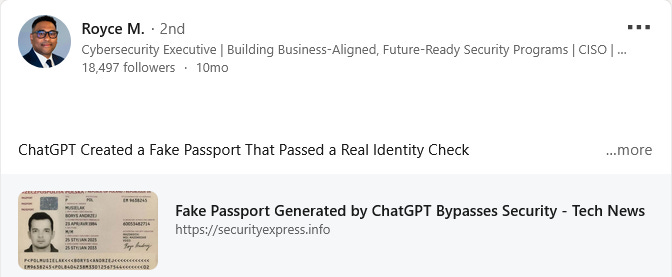
Cybersecurity executives are sounding the alarm on artificial intelligence and its ability to create fake documents and false personas called deep fakes, which can be audio or video recordings to make it appear as if someone is doing something they didn’t do.
Alarm bells are being sounded online about how ChatGPT is creating fake passports, although these types of headlines are hype.
Although the ChatGPT-fabricated passport likely would not withstand scrutiny due to the absence of an embedded chip, it proved sufficient to bypass the most basic KYC (know-your customers) procedures employed by some fintech services like cryptocurrency exchanges. In response, cybersecurity experts are calling for NFC (near field communication), which enable hardware-level authentication.
Translation: a true passport needs hardware to work at the border, which isn't being currently replicated by ChatGPT:
These types of security “recommendations” are where the fallacy of more security falls on its face, and exposes the pathetic old wizard of Oz.
If an AI-generated passport wouldn’t pass muster at airport or border security without an electronic chip, then why do we need more hardware-level authentication (e.g. electronic chips)?
We don’t, even though data harvesting and cybersecurity firms would love to sell us more technology.
Reading between the lines of cybersecurity
Here are some current recommendations being made by cybersecurity firms, and three potential ways AI could be justified to bring us into a surveillance state:
🔒 Strengthened authentication:
Use of advanced tools like NFC-enabled document checks and liveness detection to better verify user identities and spot deepfakes.
✔️ Translation: Near field communication is the ability of our devices and businesses to use radiofrequency and track our location. Retailers are drooling over more consumer data gathered by NFC.
When I left Oracle software in 2015, one of the last “tools” they discussed was stores being able to greet someone at the door, already knowing their shoe size or clothing color preference. Creepy much? I quit soon after.
🔒 Update risk models:
Regularly review and adjust fraud prevention practices to account for new AI-driven threats, rather than relying on old procedures.
✔️ Translation: AI will drain businesses and tax payers of more money, while banks who issue fraud prevention guidelines and cybersecurity executives rake in more profit.
🔒 Layer security:
Combine biometric systems, cross-checks with official databases, and AI-powered anomaly detection to make verification processes tougher to bypass
✔️ Translation: the end to all freedom and permanent data harvesting, creating eternal profits for the military industrial surveillance complex while morally and financially bankrupting the general population and future generations in perpetuity.
I don’t know about you, but I can easily spot a fake YouTube actor with artificial boobs, or a five-foot tall Chinese guy telling me that Tai-Chi walking will give me his 42 inch pectorals.
But I digress…
Does anyone remember the good ole’ days, where the biggest worry over having a fake ID was being busted by an undercover cop at the liquor store?
Many teens today pride themselves on not drinking. Good for them.
They just scroll and consume digital heroin while vaping government cannabis.
I say let’s bring back the tequila and the cool grandparents that could drink us under the table.
But now I really digress…
Let the Bots Rot the Robot
Recently I spoke with colleagues on LinkedIn who have also noticed that the platform has not been able to stop the explosion of fake profiles. The volume of false accounts continues to rise, with 156 million fake accounts blocked annually in 2025—up from 121 million in 2023. Generative AI like ChatGPT creates these profiles, primarily for marketing and lead generation. AI profiles mimic real users with convincing headshots and fabricated job histories, targeting potential customers to initiate contact before handing them off to real salespeople.
When it comes to faces generated by AI, a recent study by PNAS3 found that people have a 50% chance of guessing correctly. The research also found that some people find machine-generated faces more trustworthy because AI often uses average facial features, suspects Hany Farid, co-author of the study. Below is a sample of faces, which study participants needed to discern as fake vs real.

🤔 Can you guess which faces are real?
Can you also guess what cybersecurity professionals are proposing as the remedy to the AI identity crisis, caused by artificial intelligence?
Yes, you guessed it…
More artificial intelligence! AI-driven facial recognition is being rolled out in response, and users are being pushed to verify their identity with more security measures like selfies and uploading ID documents, which will only create less privacy and more data for AI to harvest.
Fighting fire with fire may not be a sound strategy. When it comes to AI, our only defense is our discerning, all-seeing human eye.
Now that we’ve opened Pandora’s box, we may stand to learn from the moral lessons given to us by the mythic Greeks. Pandora was given a jar by Zeus filled with all the evils of humanity, including disease, death, sorrow, greed, and strife. Driven by curiosity, she opened the jar, releasing all the evils into the world, ending the Golden Age of innocence and peace. Only Hope (Elpis) remained inside, trapped beneath the lid.
Hope can be a delusion, but it also drives us to keep moving forward in the midst of overwhelming obstacles. Coupled with determination and the human spirit, hope is what allows us to see beyond AI, to what some call the Solarpunk timeline:


Original Sin 2.0
Traveling along the yellow brick road of destiny, we’re bound to find some tin men along the way, who wouldn’t survive without the elbow grease of our sweat.
In 2023, it was discovered that almost half of Elon Musk’s followers were likely bots.4 Over 42% (around 65.3 million) of Musk’s 153 million followers in 2023 had zero followers of their own. More than 72% (nearly 112 million) had fewer than 10 followers. Musk had bought X in 2022. This example reminds me of the school bully corralling others to be his friends, and only seeing these “friends” during recess. Those same friends go home and tell their parents how much they hate how the bully pushes everyone around, without having the backbone to punch him in the face themselves.
Movies, mass media, and video games condition the collective subconscious with predictive messages, encoding our neural software to “accept future updates.”
When Metal Gear Solid 2 was released in 2001, its plot was criticized for being confusing and overly philosophical. The antagonist wasn’t a nuclear-equipped tank, but artificial intelligence. This AI, known as “The Patriots,” didn’t want to destroy humanity; it wanted to control it by filtering digital information. The game posited a future where the sheer volume of trivial information (“junk data”) would require algorithms to curate what people saw, effectively allowing those algorithms to shape truth.
Even more concerning is the fact that artificially predictive intelligence (API) can transform our very soul and make us believe… in make-believe. Techno tyranny sprouts from the deeply-embedded emotional software of religion, as we’re programmed to think we’re the “sinner” if we dare question the perverted rhetoric of its high priests. Like a battered spouse, we accept our doom because we had it coming.
Thanks to groups like the Christian Transhumanist Association, which believes AI is what God wants, original sin has gotten an upgrade. Silicon Valley billionaire Peter Thiel has claimed the moral high ground, calling those who resist AI “the antichrist.”
What can we do about it?
Six years ago, we were given a choice to partake in a masquerade.
Some of us chose to lose face by losing the face mask.
A few of us chose to lose our job as a result.
Yet many of us gained a livelihood instead. At the very least, we preserved our honor and dignity by not participating in the drill of human degradation.
Now a new event horizon approaches, and we face a choice.
Do we submit our most intimate details, and cut off the windpipe of human potential just so we can come up gasping for air once in a while?
Or do we stand firm, no matter the consequences?
Looking up at the sky past the desolate creek bed, I’m reminded of the hawk we saw recently.
Perched upon a tree, this bird watched the entire landscape for the entire day, with an unflinching assuredness that it would catch its prey, and feed its young.
Confidence. Calm. Patience.
This is the synergistic emotional elixir of the apex predator, who stalks in silence.
By walking slowly, and watching artificial intelligence as an unattached observer, we can stay ahead.
In the ocean of artificial intelligence, many of us feel overwhelmed.
Yet in each of us is contained a drop of an ocean immortal to time.
With each action, we replete the rivers of Mother Earth with the tear of joy.
Each time we:
Choose to read instead of watching television.
Turn off the light, and let a candle light our night.
Lift our head from our phone and lift our hearts to the sky.
Learn a skill that will last forever.
Walk one step for love.
Take one leap over the river with God.

👉 P.S. Need help reducing EMF in your home?
WANT TO REDUCE EMF IN YOUR LIFE?
Improve sleep, increase focus, and boost metabolism...
Don't live zapped. Live with zest!